
ATTIC INSULATION · PHOENIX & MESA
Most of your AC goes out the lid.
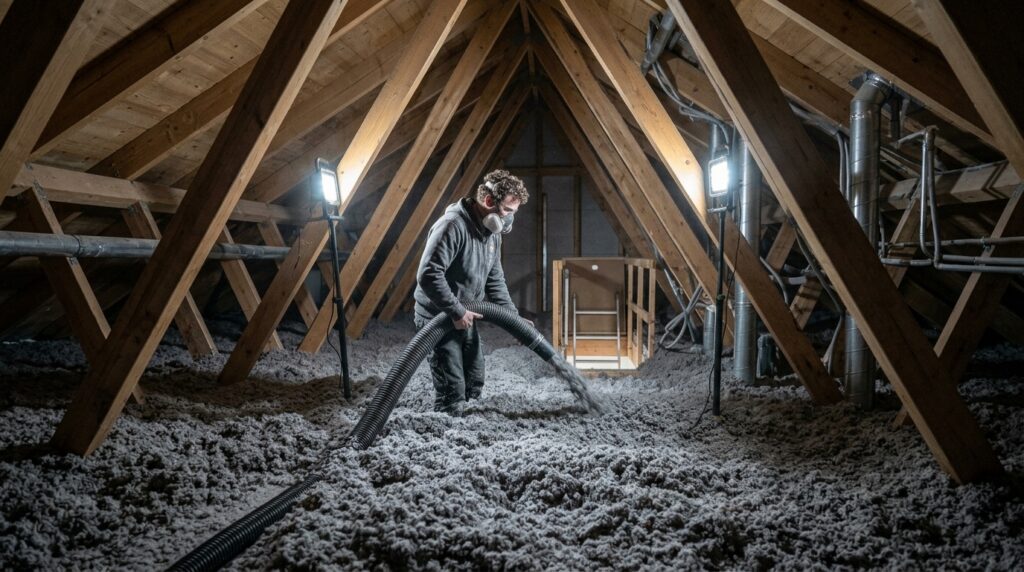
A Phoenix attic in July hits 150°F. If yours is sitting at R-19 — half the recommended value — your air conditioner is fighting a furnace overhead. We air-seal, blow R-49, and quietly take a third off your summer bill.
R-49
Target R-value
25–35%
AC runtime reduction
$1,200
Federal tax credit
25yr
Material lifespan
Your attic is telling you something.
Three symptoms that point to under-insulated ceilings
01
Rooms won't cool below 80°F
Your AC runs all day but upstairs rooms stay hot. Heat is radiating through an under-insulated ceiling — not a thermostat problem.
02
Electric bills spike in June–Sep
A 30%+ jump in summer bills often traces to an attic sitting at R-19 instead of the code-minimum R-38.
03
AC cycles every 15 minutes
Short-cycling compressors wear out fast. The fix is usually above your ceiling, not inside your mechanical room.
What we install
Three insulation types, each with a role. We recommend the right one based on your attic geometry and existing R-value.
Most Common
Cellulose
R-3.7 / inch
Blown-in recycled paper. Fills irregular spaces completely. Best for topping up existing insulation to R-49.
Fiberglass
R-2.9 / inch
Loose-fill or batt. Lower cost. Works well in large, accessible attics with standard joist spacing.
Air Sealing
Spray Foam
R-6.5 / inch
Closed-cell foam seals and insulates simultaneously. Used at rim joists and penetrations before blown insulation.
The gap between what you have and what you need
Most Phoenix homes were built with R-19. The DOE recommends R-49–R-60 for Zone 2 climates.
R-19
What most Phoenix homes have
Half the recommended value. Your AC is fighting a furnace overhead.
→
R-49
What we install
DOE-recommended for Arizona Zone 2. Cuts your AC runtime by 25–35%.
How it works
Four steps from sign-off to sealed attic — usually done in one day.
1
Free attic inspection
We measure your current R-value, map air leaks, and document the condition of existing insulation. No sales pressure — just data.
2
Custom scope & quote
We recommend the minimum intervention needed to hit R-49: air sealing, baffle installation, and blown-in insulation.
3
One-day installation
Our crew air-seals penetrations with spray foam, installs baffles at eaves, then blows in cellulose or fiberglass to R-49.
4
Post-install verification
We measure final depth at 10 points across your attic and photograph the job. You keep the report.
Why homeowners insulate
Five tangible outcomes, backed by real numbers.
⚡ 25–35% lower energy bills
Measured utility savings for Phoenix homes upgraded from R-19 to R-49, per APS rebate program data.
🌡 More stable temperatures
Properly sealed attics keep indoor temps within 2°F of thermostat set-point even at 115°F outside.
🏠 Higher resale value
Homes with R-49 attic insulation list 3–5% higher in the Valley and sell faster per Zillow insulation studies.
💰 Up to $1,850 in rebates
$1,200 federal tax credit + up to $400 APS rebate + $250 SRP rebate when you meet program requirements.
🌿 Lower carbon footprint
Less grid demand means fewer peak-hour power plant emissions. R-49 attic work qualifies for Energy Star certification.
Five mistakes that cancel out insulation gains
Even a well-installed R-49 job underperforms if any of these are present. We check all five before we start.
➥
Skipping air sealing
Insulation without air sealing is like wearing a sweater with holes. Every electrical box, plumbing penetration, and top plate gap leaks conditioned air directly into the attic.
➥
Wrong insulation for the geometry
Fiberglass batts in attics with irregular framing leave gaps. Blown-in material conforms to any shape. Matching the material to the space is step one.
➥
Burying soffit baffles
Blocking eave ventilation to add depth causes moisture accumulation. Baffles must be installed before blowing to maintain a clear path from soffit to ridge.
➥
Ignoring attic HVAC ducts
If your duct system runs through an uninsulated attic, you’re pushing conditioned air through a 150°F oven. Duct sealing often returns as much savings as insulation.
➥
Measuring depth, not R-value
Settled cellulose reads lower than fresh. We use a calibrated probe and account for settling rate, not just tape-measure depth, to confirm actual R-value.
Stack the rebates
Three incentive programs currently available to Arizona homeowners who upgrade to R-49.
$1,200
Federal Tax Credit (25C)
Insulation & air sealing that meets efficiency standards qualifies for a dollar-for-dollar tax credit. No income limit. Claim on Form 5695.
$400
APS Home Performance
APS pays $0.12/kWh saved, up to $400 for qualifying attic insulation upgrades. We handle the paperwork.
$250
SRP Energy Efficiency
SRP customers get a flat $250 rebate when insulation is installed to R-38 or higher by a certified contractor.
Total available incentives
Up to $1,850 back
Frequently asked questions
What Phoenix homeowners ask before booking an attic audit.
How long does attic insulation installation take?
Most single-family homes take 4–6 hours from setup to cleanup. We’ll have your attic at R-49 and the truck packed up the same day we start.
Do I need to remove old insulation first?
Usually no. If existing insulation is in good condition and not contaminated, we air-seal over it and blow on top. Removal adds cost and is only necessary when there is moisture damage or pest activity.
How do I know if my current insulation is working?
Check your attic floor depth. Fiberglass batts at standard depth are roughly R-19. If you measure less than 10 inches of blown insulation, you’re almost certainly under the code minimum.
What is the payback period?
Homeowners typically recover the net-of-incentive cost in 3–5 years through utility savings. That assumes a full upgrade from R-19 to R-49 in Phoenix climate.
Can attic insulation help with soundproofing?
It helps somewhat with airborne noise. For meaningful acoustic improvement you’d also want to address wall cavities and windows — insulation alone won’t make a dramatic difference in sound.
Stop air-conditioning the sky.
We’ll come out, measure your current R-value, and tell you exactly what it will cost to fix it — no obligation.